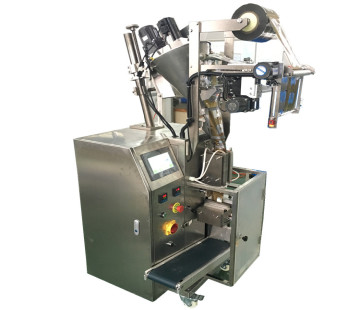
This type of film uses a single plastic resin as its raw material. The process is simple and the cost is low, making it suitable for products with low requirements for barrier properties and strength. Its core advantages are good heat-sealing properties and ease of processing.
OPP Film (Biaxially Oriented Polypropylene Film)
Composition: Made from polypropylene resin through biaxial stretching.
Core Characteristics: High transparency (good gloss), moderate stiffness, excellent heat-sealing properties (heat-sealing temperature 120-160℃, wide heat-sealing window), but its barrier properties (moisture resistance, oxidation resistance) are average, and it is prone to becoming brittle at low temperatures.
Applicable Products: Dry foods such as biscuits, candies, potato chips, and snacks, as well as daily necessities such as stationery and small hardware.
Equipment Compatibility: No special configuration is required. It is compatible with conventional pillow packaging machines (mechanical or servo-driven), with a speed of 400-500 packs/minute, suitable for high-speed production.
CPP Film (Cast Polypropylene Film)
Composition: Made from polypropylene resin using a casting process (no stretching).
Key Characteristics: Superior softness compared to OPP film, lower heat-sealing temperature (110-150℃), good low-temperature heat resistance (can withstand microwave heating), but slightly lower transparency and stiffness than OPP.
Suitable Products: Bread, pastries, cooked foods (such as braised dishes), fresh-cut fruits, and other products requiring a certain degree of flexibility in packaging. It can also be used as the heat-sealing inner layer of composite films.
Equipment Compatibility: Due to its low stiffness, high-speed conveying requires equipment equipped with a precise tension control system to avoid wrinkles. A standard speed of 200-350 packs/minute is recommended.
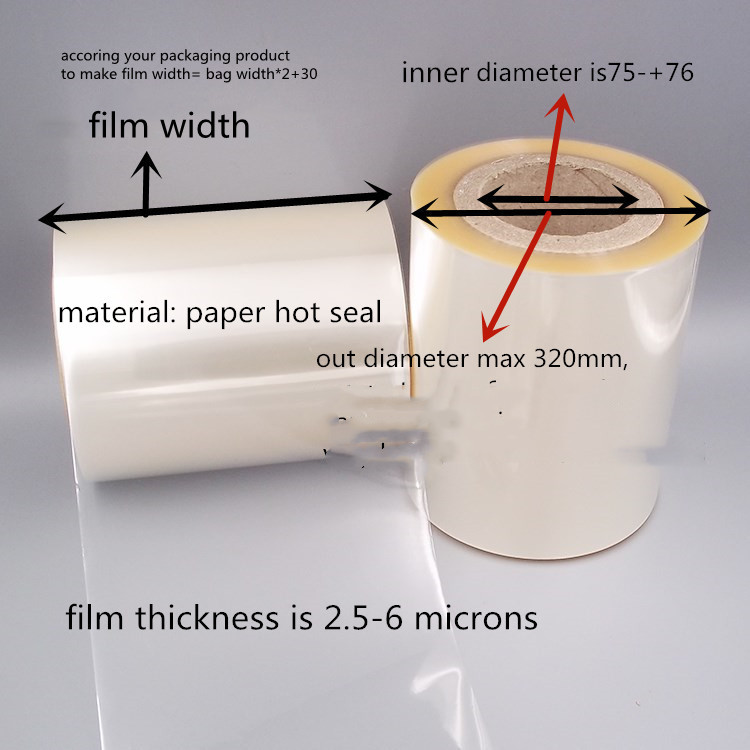
PE Film (Polyethylene Film, including LDPE and LLDPE)
Composition: Made from low-density polyethylene (LDPE) or linear low-density polyethylene (LLDPE).
Key characteristics: Soft texture, strong impact resistance, good water resistance, wide heat-sealing temperature range (120-180℃), high heat-sealing strength (LLDPE is superior to LDPE), but generally low transparency and poor stiffness.
Suitable products: Daily necessities (such as tissues, masks, garbage bags), frozen foods (such as frozen dumplings, seafood), liquid packaging (such as small bags of soy sauce, requiring thicker PE film).
Equipment compatibility: Due to its softness and stretchability, the equipment needs to use anti-slip conveyor rollers (such as textured rubber rollers) and reduce tension. A speed of 150-300 packs/minute is recommended to avoid film deformation.
PVC film (polyvinyl chloride film)
Composition: Made of polyvinyl chloride resin, with some added plasticizers and heat stabilizers.
Key characteristics: Good heat shrinkage (heat shrinkage rate > 5%), high transparency, low cost, but poor thermal stability (easily decomposes at high temperatures), some contain environmental controversies (food packaging requires plasticizer-free grade).
Applicable Products: Toys, stationery, small hardware, and other products requiring tight packaging, or as heat-shrink packaging (e.g., batteries, CDs).
Equipment Compatibility: Requires equipment equipped with a cooling system (to inhibit shrinkage and deformation). Heat-sealing temperature needs precise control (130-150℃) to avoid carbonization. Recommended speed is 100-200 packs/minute.
II. Composite Material Film: Multifunctional, suitable for high-requirement packaging needs
This type of film is composed of two or more different materials (e.g., an outer strength layer + an inner heat-sealing layer), balancing transparency, barrier properties, and strength. It is the mainstream choice for the food and pharmaceutical industries.
PET/PE Composite Film
Structure: Outer layer is PET (polyethylene terephthalate, high strength, high transparency), inner layer is PE (polyethylene, responsible for heat sealing).
Key Features: Combines the stiffness and abrasion resistance of PET with the heat-sealing properties of PE. Its barrier properties (moisture resistance, puncture resistance) are superior to single-layer films. High transparency makes it suitable for printing complex patterns.
Applicable Products: Chocolate, nuts, meat snacks (such as beef jerky), and pharmaceutical aluminum-plastic composite sheets (such as pillowcases outside blister packs).
Equipment Compatibility: Due to its high stiffness and smooth conveying, it is compatible with high-speed machines (300-500 packs/minute). The heat-sealing temperature needs to be compatible with the PE inner layer (120-160℃).
NY/PE Composite Film (Nylon/Polyethylene Composite Film)
Structure: Outer layer is NY (nylon, puncture-resistant, high toughness), inner layer is PE (heat-sealing layer).
Key Features: Strong puncture resistance (resistant to scratches from sharp products), high tensile strength, excellent barrier properties (oxygen and odor prevention), suitable for products containing oils or easily oxidized products.
Applicable Products: Foods with broth (e.g., instant noodle seasoning packets, small sauce packets), fried foods (e.g., potato chips, rice crackers), pet food.
Equipment Compatibility: Due to nylon's hygroscopic nature, ensure the film material is stored in a dry environment (humidity < 60%). The heat-sealing temperature should be controlled at 130-170℃, with a speed of 250-400 packs/minute.
Aluminum-Plastic Composite Film (Aluminum Foil/Plastic Composite Film)
Structure: Commonly "PET/Aluminum Foil/PE" or "NY/Aluminum Foil/PE". The outer layer is strong, the middle aluminum foil layer provides barrier properties, and the inner PE layer is heat-sealed.
Core Characteristics: Extremely strong barrier properties (completely moisture-proof, oxidation-proof, and UV-proof), good light-blocking properties, extending product shelf life, but opaque (cannot be traced using a photoelectric eye for color marking), high heat-sealing temperature.
Applicable Products: Pharmaceutical products (e.g., capsules, powders), health foods (e.g., protein powder, vitamins), and foods requiring long-term storage (e.g., tea, dried goods).
Equipment Compatibility: Requires a high-temperature heat-sealing system (180-220℃). Due to its opacity, mechanical positioning is necessary (e.g., triggering sealing and cutting based on product length). A speed of 200-300 packs/minute is recommended.
III. Special Scenarios and Suitable Film Materials: Meeting Personalized Packaging Needs
In addition to the mainstream film materials mentioned above, some special scenarios require the selection of specific materials to achieve specific functions (e.g., heat shrinkage, environmental friendliness, temperature resistance).
Heat Shrink Film (e.g., POF, PVC Heat Shrink Film)
Composition: POF film is a polyolefin co-extruded film (PP+PE), and PVC heat shrink film is made of polyvinyl chloride.
Core Characteristics: High shrinkage rate after heating (POF film transverse shrinkage rate > 50%), allowing for tight wrapping of products, good fit, suitable for irregularly shaped or multi-piece combinations.
Applicable Products: Stationery sets, toy sets, bottled beverage labels (shrink sleeve labels), hardware tool sets.
Equipment Compatibility: Requires a heat shrink tunnel (temperature 120-160℃) after the pillow packaging machine. Packaging speed is limited by the efficiency of the shrink tunnel, generally 150-250 packs/minute.
Paper-based Composite Film (e.g., paper/PET/PE)
Structure: Outer layer is kraft paper or white cardboard (environmentally friendly, printable), middle PET layer for strength, inner PE heat-sealing layer.
Core Characteristics: Environmentally friendly and recyclable, with a substantial feel, combining the stiffness of paper with the heat-sealing properties of plastic, suitable for products emphasizing an environmentally friendly image.
Applicable Products: Baked goods (e.g., bread, cakes), agricultural products (e.g., tea, grains), high-end daily necessities (e.g., handmade soaps).
Equipment Compatibility: Due to the stiffness of the paper layer, the conveyor roller pressure needs to be moderate to avoid paper damage. The heat sealing temperature should be compatible with the PE inner layer (120-160℃), and the recommended speed is 100-200 packs/minute.
IV. Summary of Core Selection Logic
Selection by Product Characteristics: For dry foods (e.g., biscuits), choose OPP film; for oily/saucer-based foods (e.g., sauces), choose NY/PE composite film; for foods requiring long-term storage (e.g., pharmaceuticals), choose aluminum-plastic composite film; for environmental requirements, choose paper-based composite film.
Selection by Equipment Capacity: Standard mechanical models are suitable for low-requirement film materials such as OPP and CPP; fully servo-driven models can adapt to special film materials such as aluminum-plastic film and heat-shrinkable film (requires upgrades to the heat sealing and cooling systems).
Selection by Cost Budget: Single films (OPP, PE) have low costs and are suitable for small to medium production capacity; composite films (PET/PE, aluminum-plastic film) have higher costs but more comprehensive performance and are suitable for high-requirement products.